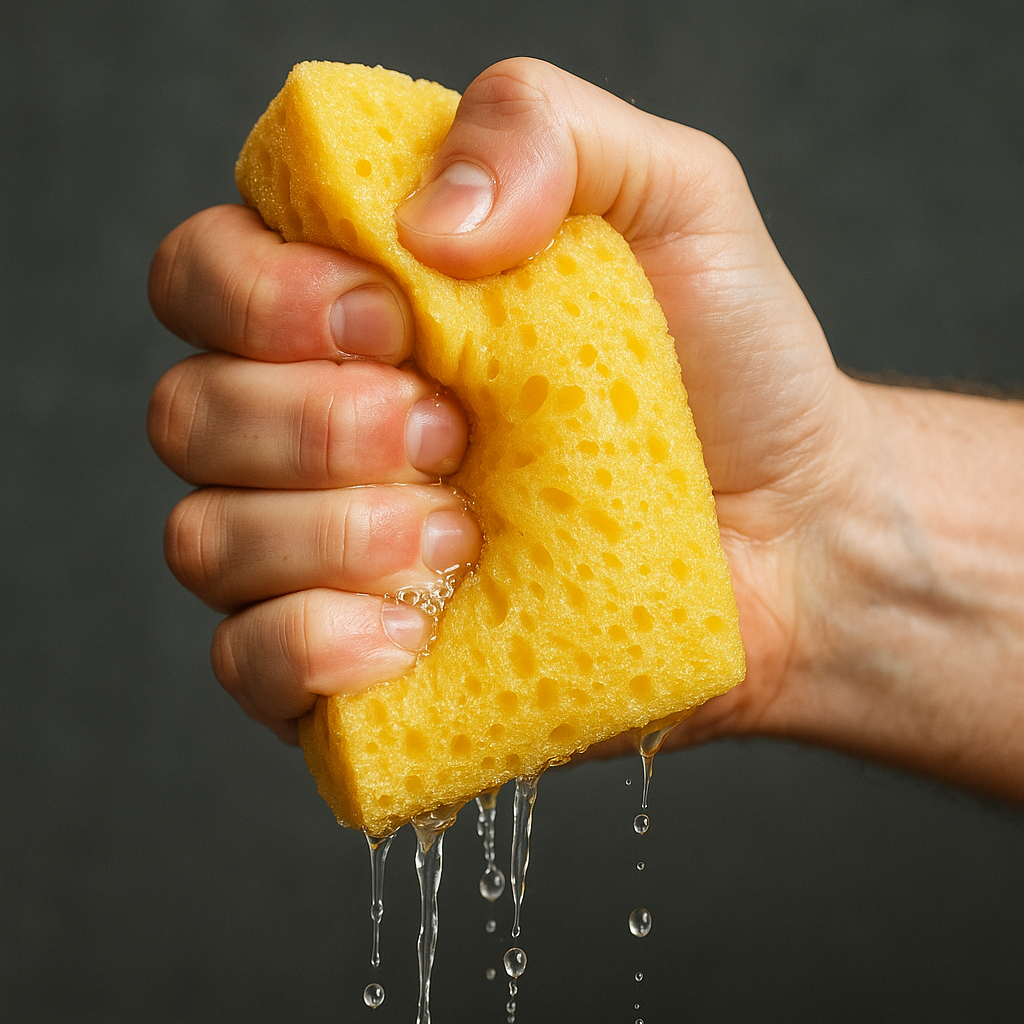
Before answering, let’s go over a few concepts. Relative Humidity, the one expressed as a percentage, is what we read on home sensors or weather stations; roughly speaking, it represents the percentage of water vapour in the air, relative to the maximum (100%) the air can hold AT THAT TEMPERATURE: it is “Relative” because it depends on temperature! (on pressure too… but negligibly for our purposes). To explain it during our training courses we use the analogy of a sponge: air is like a sponge, and the colder it is, the more it is “wrung out”.If I take a sponge and pour water onto it, it will soak it up without dripping: the amount of water we pour is the Absolute Humidity.How do we make the sponge drip? We have two options:1) We add more water (we increase the Absolute Humidity): at some point it will no longer be able to absorb water and will start to drip. We have reached saturation, which is to say 100% Relative Humidity: just as the sponge drips, so the vapour in the air condenses on the floor or on cold glass.2) We can make the sponge drip WITHOUT adding water: we can wring it out, and COOLING THE AIR IS LIKE WRINGING THE SPONGE. We are not adding water, but we are still reducing the sponge’s capacity to hold it, so at some point the water comes out: by cooling the air we are effectively “wringing the sponge”, and the vapour that was quietly held in suspension condenses.The Absolute Humidity (the amount of water) has NOT changed, but the air’s capacity to hold it has, and therefore so has the relative humidity: we have gone from a relative humidity of, say, 60% to one of 100%.This is why it can be neither raining nor foggy outside and yet condensation can still form on the radiant floor: the outside air may be at 30°C with 60% Relative humidity (relative to those 30°!); then that air comes into the house and, with no change in the amount of water it contains, it is cooled… we are wringing the sponge.When will it start to drip? Dropping the metaphor: as the air cools, at what temperature will condensation form?At the temperature which, as it happens, is called the “Dew Point”: in our example (60% at 30°C) the dew point is 21.4°C, so if the outside air reaches our floor at 20° without being dehumidified, condensation will form (if you search for “DewPoint Calculator” on Google you will find plenty of pages to run these calculations and experiment with other figures).So which is the right parameter to use to control the system? Absolute humidity or Relative?It depends on our intent: in the coming posts we will look at the scenarios in which we want to measure and control humidity, and we will assess case by case which value is the right one to consider — perhaps with a few surprises.