



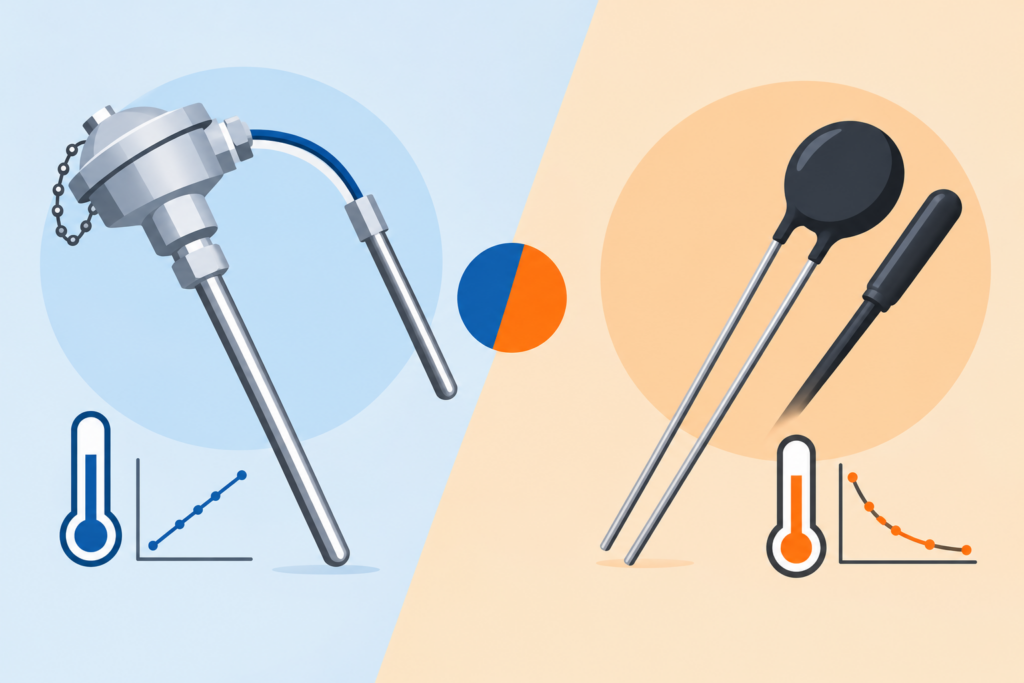
Have you noticed? In the past, Pt100 and Pt1000 probes were a very common choice in electronic boards. Today, in many temperature control applications, NTC thermistors have become the most widely used solution. And yet, at least on paper, they would seem to be the worse choice.
Pt100 and Pt1000 are platinum RTD (Resistance Temperature Detector) sensors characterized by a positive temperature coefficient: their resistance increases as the temperature rises. They are stable, accurate, and relatively linear. A Pt100 has a resistance of 100 Ω at 0 °C and changes by approximately 0.385 Ω/°C near that temperature. A Pt1000 follows the same principle, but its nominal resistance and sensitivity are ten times higher. The relationship between resistance and temperature is therefore predictable and relatively straightforward to handle.
NTC thermistors (Negative Temperature Coefficient) work in the opposite way: their resistance decreases as the temperature rises. They are generally made from semiconductor ceramic materials and exhibit a strongly nonlinear characteristic. For example, a 10 kΩ NTC has a nominal resistance of 10,000 Ω at 25 °C, but its resistance changes significantly even with a difference of just a few degrees. To derive the temperature from the resistance, it is therefore necessary to use a formula, a conversion table, or a linearization algorithm based on the specific component’s characteristic curve. Less linearity, then, and more processing.
So why have NTC thermistors become so widespread?
The first reason is cost. NTC thermistors are generally inexpensive to manufacture, compact, and available in a wide variety of formats. In mass production, even a few cents saved per sensor can significantly affect the overall cost of thousands of electronic boards.
The second reason is the simplicity of the measurement circuit. An NTC can be connected to a simple resistive voltage divider, whose output voltage is read by a microcontroller’s ADC. The firmware calculates the resistance and converts it into temperature. A Pt100, on the other hand, exhibits very small resistance changes: approximately 0.385 Ω per degree. Accurate measurements require careful management of the measurement current, self-heating, acquisition resolution, and errors introduced by the connections. Dedicated circuits are often needed, adding to the cost. The Pt1000 mitigates some of these issues thanks to its ten-times-higher nominal resistance, but it still requires a suitable measurement circuit.
The real change, however, has taken place in electronics. These differences existed twenty years ago as well, but back then, compensating for an NTC’s nonlinearity could require analog circuits or computing resources that were not always cost-effective. Today, microcontrollers are inexpensive, incorporate analog-to-digital converters, and can easily perform the necessary calculations. A conversion formula or lookup table has virtually negligible computational cost. Nonlinearity, once a hardware problem to solve, has become primarily a firmware issue.
Wiring also plays a role. A 10 kΩ NTC has a relatively high resistance compared with a Pt100, so cable resistance generally has a smaller effect on the reading. With a Pt100, just a few additional ohms from the wiring can introduce significant errors. Three-wire or four-wire connections can compensate for these errors, but they increase system complexity. The Pt1000 reduces the problem without eliminating it. NTC thermistors are also affected by connection resistance, of course: the magnitude of the error depends on the operating temperature and the required measurement accuracy.
Finally, NTC thermistors offer high sensitivity over relatively narrow temperature ranges, making them ideal for refrigerators, air conditioners, boilers, heat pumps, batteries, and power supplies. This does not mean that they are inherently more accurate: tolerance, stability, noise, self-heating, and calibration remain decisive factors.
Pt100 and Pt1000 sensors are by no means obsolete. They remain the preferred choice when stability, repeatability, interchangeability, and accuracy over a wide temperature range are required. NTC thermistors, on the other hand, are the better option when the temperature range is limited, cost is a key consideration, and a microcontroller can easily compensate for their nonlinearity.
Ultimately, it is not that one sensor has become universally better than the other. What has changed is the trade-off between performance, cost, and the electronics required. When an NTC thermistor, a resistor, and an ADC input are enough to achieve the required accuracy, a more expensive and complex solution does not necessarily offer any tangible benefit.
Have a great day at work!
