



regCOFFEE: Heating, Ventilation and Air Conditioning control and remote management with a new aroma
Coffee is the new control and supervision platform by Setecna EPC, built on Linux Embedded and natively connected to the network. It was designed for installations that used to get complicated with the REG System: large buildings, articulated plants, ModBUS integrations, real-time monitoring.
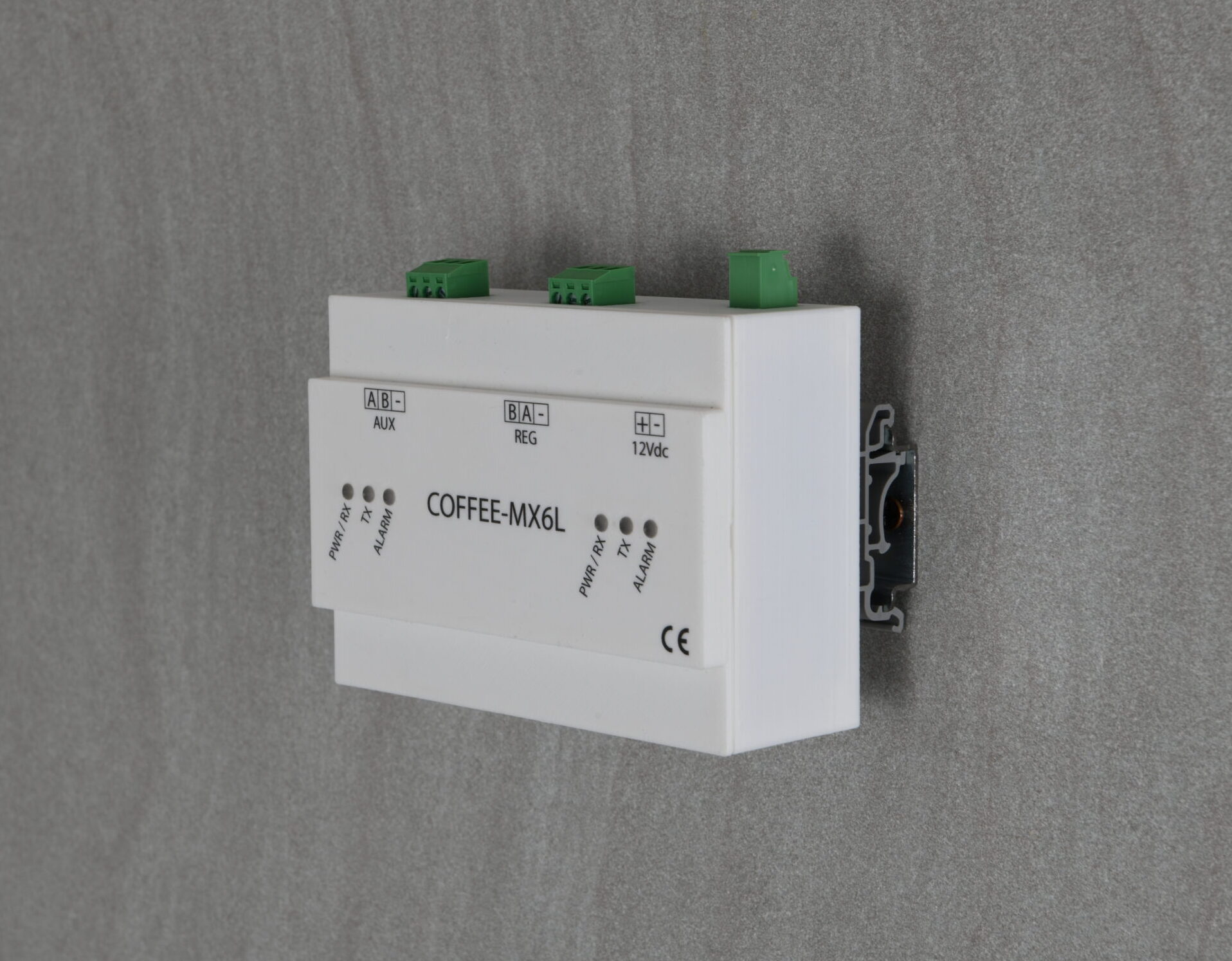
The Master has no on-board I/O: it interfaces over Ethernet and two isolated RS485 buses, one towards REG System devices and one towards the ModBUS world.
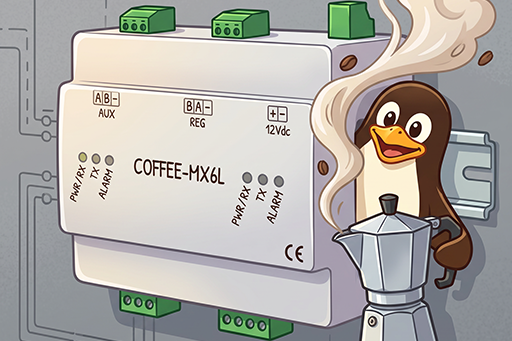
This is not an evolution. It is a revolution.
Between the REG System of 2012, the DOT of 2018 and Coffee there is a change of category, not an update: the processor changes, the memory changes, the operating system changes and above all the way the system communicates changes.
ARCHITECTURE
From the 8 bit of REG and the 32 bit Cortex M4 of DOT we move to a 32 bit Cortex A7, with a dynamic clock up to 800 MHz.
MEMORY
512 MB of FLASH and 512 MB of RAM, against the 128 KB and 4 KB of REG: practically unlimited capacity for trends and configurations.
OPERATING SYSTEM
Linux Embedded customised, in place of the bare-metal of REG and the FreeRTOS of DOT.
NETWORK
A native LAN interface and TCP/IP communication as the founding layer of the system, at every level, internal ones included.
When to choose Coffee instead of the REG System
The REG System remains the right choice for the majority of installations: it is adequate, reliable and well established.
Coffee comes into play when you need capabilities that REG does not have:
LARGER AND MORE COMPLEX PLANTS
Installations with many zones, or complex logics that REG cannot control adequately
MODBUS DEVICES
The built-in ModBUS port lets you manage ModBUS devices natively, with no additional hardware and no driver development
REAL-TIME MONITORING
State-of-the-art protocols for immediate remote updating
LOCAL WEB SERVER
To integrate local displays, smart TVs and home automation systems, all locally, without going through the Cloud, built into the master
More complex installations, made simpler
Fourteen years of the REG System taught us which situations became complicated. In Coffee they are native.
THE NEW ZONES, FAR MORE VERSATILE AND POWERFUL
Each Zone natively handles a double command — radiant plus fancoil, towel rail, air, 4-pipe systems — and has an independent PID, usable for the speed of a fancoil, a 0/10 or PWM actuator, the opening of a damper.
INNOVATIVE CONTROL LOGICS
Control of Absolute Humidity and of Perceived Temperature (Heat Index). The links with Manifolds, Timers and Dehumidifiers can be far more articulated: one manifold for the radiant system and one for the integration, one for winter and one for summer.
THE NEW AIR HANDLING DEVICES
The old concept of Dehumidifier gives way to the Air Handling Device: from simple MVHR up to a complete AHU, with two fans, pre- and post-heating coils and recirculation dampers. Each AHD provides up to 4 PIDs.
THE NEW MANIFOLDS
Each manifold handles an independent list of sources, up to 16 callable (8 for summer and 8 for winter), with independent priorities per season and up to 8 parent or interlocked manifolds.
THE NEW SOURCES
Up to 16 sources, each with temperature control via 0/10, ModBUS or digital commands, power control with a dedicated PID, exchanger compensation and setpoint calculation. Cascades are implemented with an ad hoc system: several cascades in the same installation.
FUNCTIONS AND INTERCON FABRIC
Up to 128 logical and mathematical functions, each with an independently chosen operator. And with the Intercon Fabric every signal, setpoint or sensor, acquired or calculated, can become the input of another subsystem.
A concrete example
A 4-pipe system, an antagonist plant, management of MVHR, dehumidification and integration, and electric radiant heating.
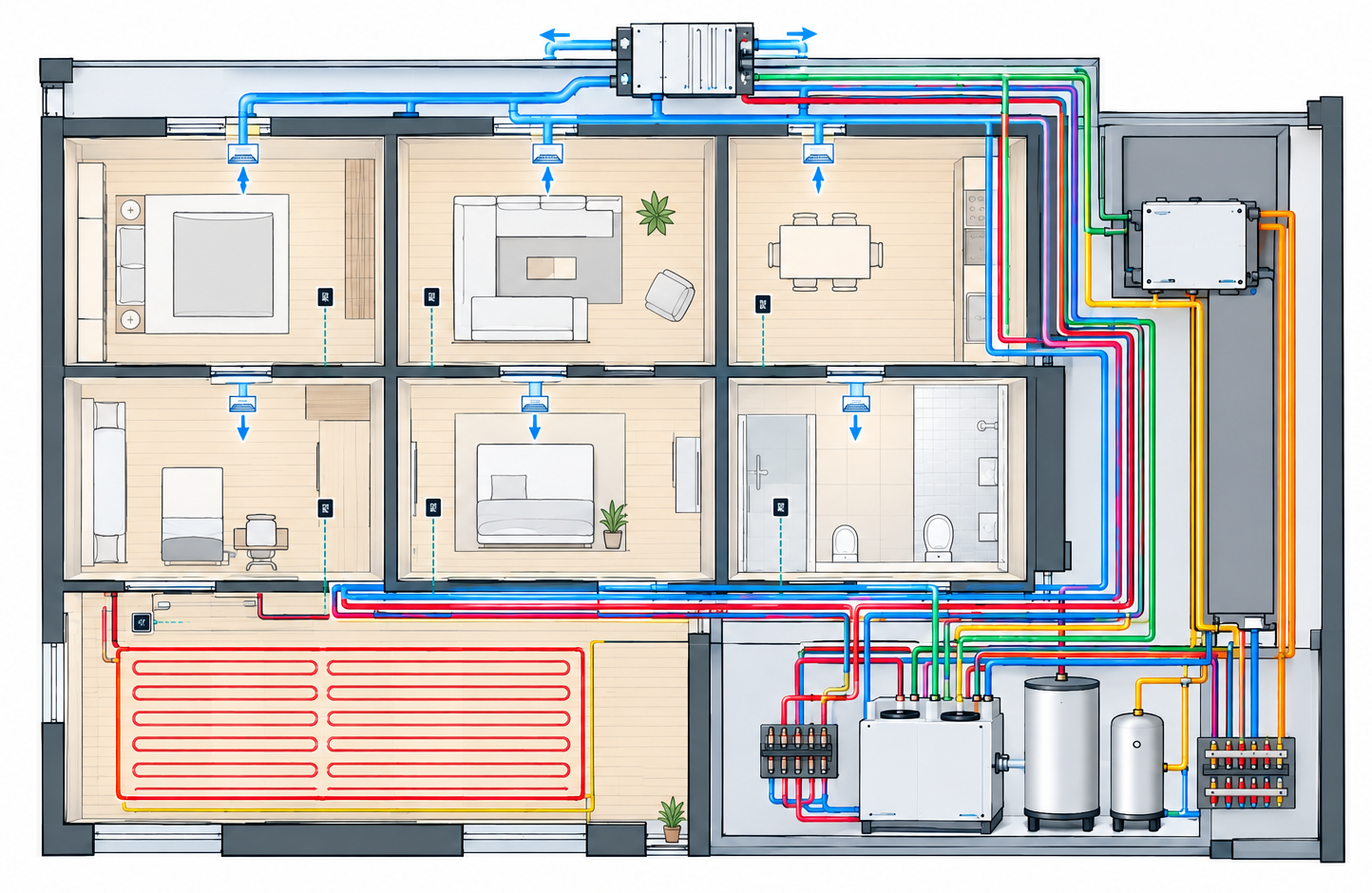
The same installation, two systems
A concrete example: same functions, same installation, two platform generations fourteen years apart.
WITH THE REG SYSTEM
It took 3 Masters — that is, three separate installations — for a total of about fifty zones.
WITH COFFEE
6 Zones were enough.
WHAT CHANGES
It is not only a matter of numbers: configuration and maintenance complexity drops in the same proportion.
Larger installations
The processing power and memory of regCOFFEE make it possible to manage very large and complex installations. The most powerful version can handle:
128 ZONES
Each zone can handle a room, even with dual systems (e.g. radiant plus fancoil), and with 0/10V PID control
32 TIMERS
The widest programming freedom, with different time programmes for summer and winter, and much more
32 CIRCUITS
Direct, mixed, parent/child or interlocked: any plant configuration can be handled
16 SOURCES
Boilers, Heat Pumps, Heating Elements, Thermo-fireplaces and every other option is allowed, single or in cascade configuration
128 FUNCTIONS
Logical or mathematical, to handle even the most tricky situations
512+512 I/O
Through REG or ModBUS expansions, you can manage all the I/Os you need
Where it fits
The goal is stated openly: to go after the market today held by high-end systems for complex buildings.
HOSPITALITY AND HEALTHCARE FACILITIES
Hotels, hospitals and service facilities, where the number of zones and continuity of operation are the main constraint.
CENTRALISED AIR SYSTEMS
Ducted distribution with dampers and per-zone control, handled by the independent PID of each Zone.
INSTALLATIONS WITH COMPLEX AHUs
Air handling units with double fan, pre- and post-heating coils and recirculation, handled by the AHDs with their 4 PIDs.
ENERGY INTEGRATIONS
Installations with photovoltaics, inverters and battery systems, where the choice of source depends on several variables in real time.
A true Internet of Things system
Basing the system on Linux means having TCP/IP communication as its foundation, at every level, internal ones.
The LAN interface is native and can be used for several functions at the same time: connecting to the CoffeeGrinder configuration software, connecting to the CoffeeCloud, communicating with ModBUS over TCP/IP devices as both master and slave, and extending the reach of the ModBUS or REG buses by using the network cabling already present in the building.
State-of-the-art communication, true real time
The protocols adopted by Coffee are closer to those used to stream films than to the serial protocols used until yesterday.
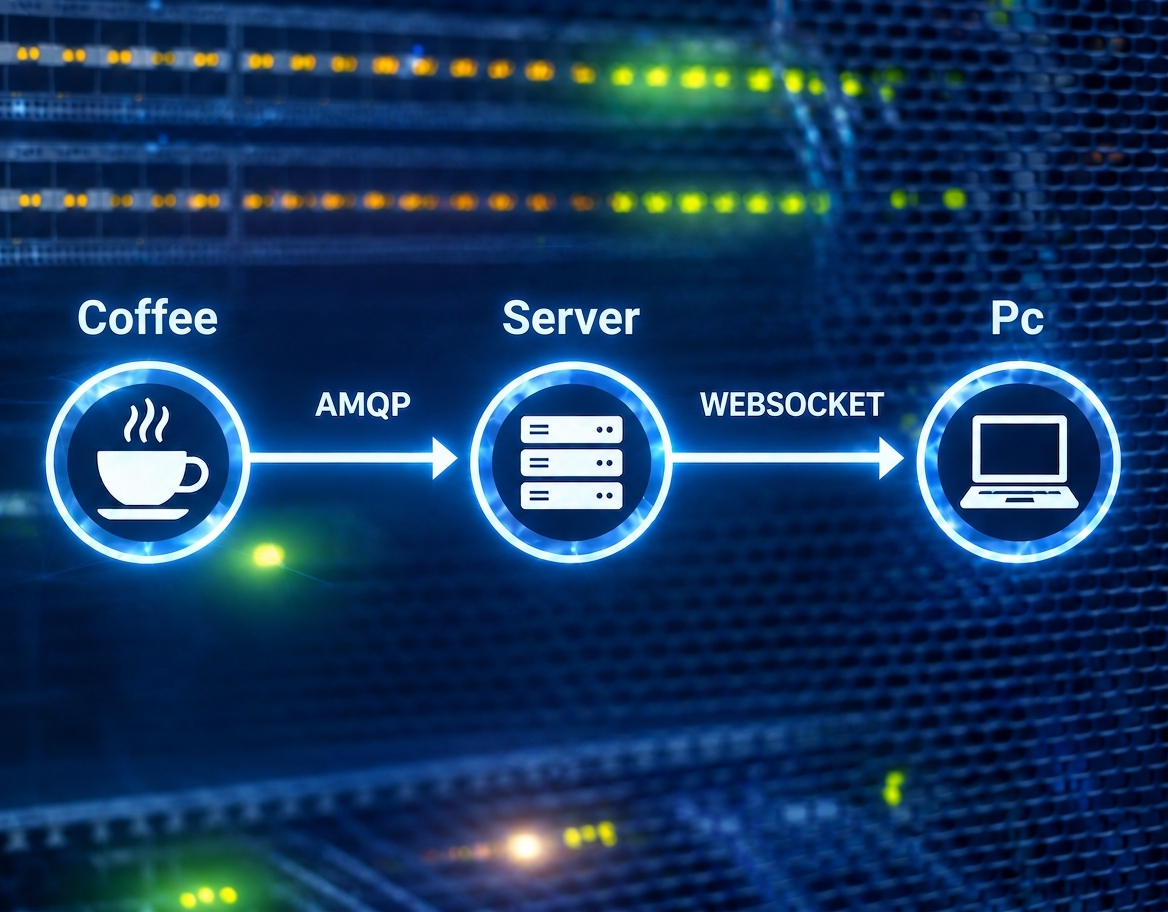
Events and push technologies
If nothing happens, we transmit nothing. But if something happens — anything at all — it is transmitted immediately.
REAL TIME
Between the change in the field and its display on the cloud there are milliseconds, not polling cycles.
SEVERAL PEOPLE TOGETHER
Several people can work together, locally or remotely, via WebApp or API, on the same installation: anyone’s changes propagate instantly to everyone else.
SECURITY
All protocols are based on advanced authentication and encryption, ready for compliance with the Cyber Resilience Act.
Native interfacing with ModBUS systems, without UGW
The RS485 serial interface and the Ethernet port make the system directly connectable to ModBUS systems.
The RS485, isolated, can act as master or as slave. The TCP/IP port can act simultaneously as master and slave. And further ports can be added to the system through USB-to-RS485 or Ethernet-to-RS485 converters.
Advanced monitoring
Practically unlimited memory and network capacity, minimal latency and native ModBUS interfacing: put together, they change what can be measured.
From the trend to the data you need
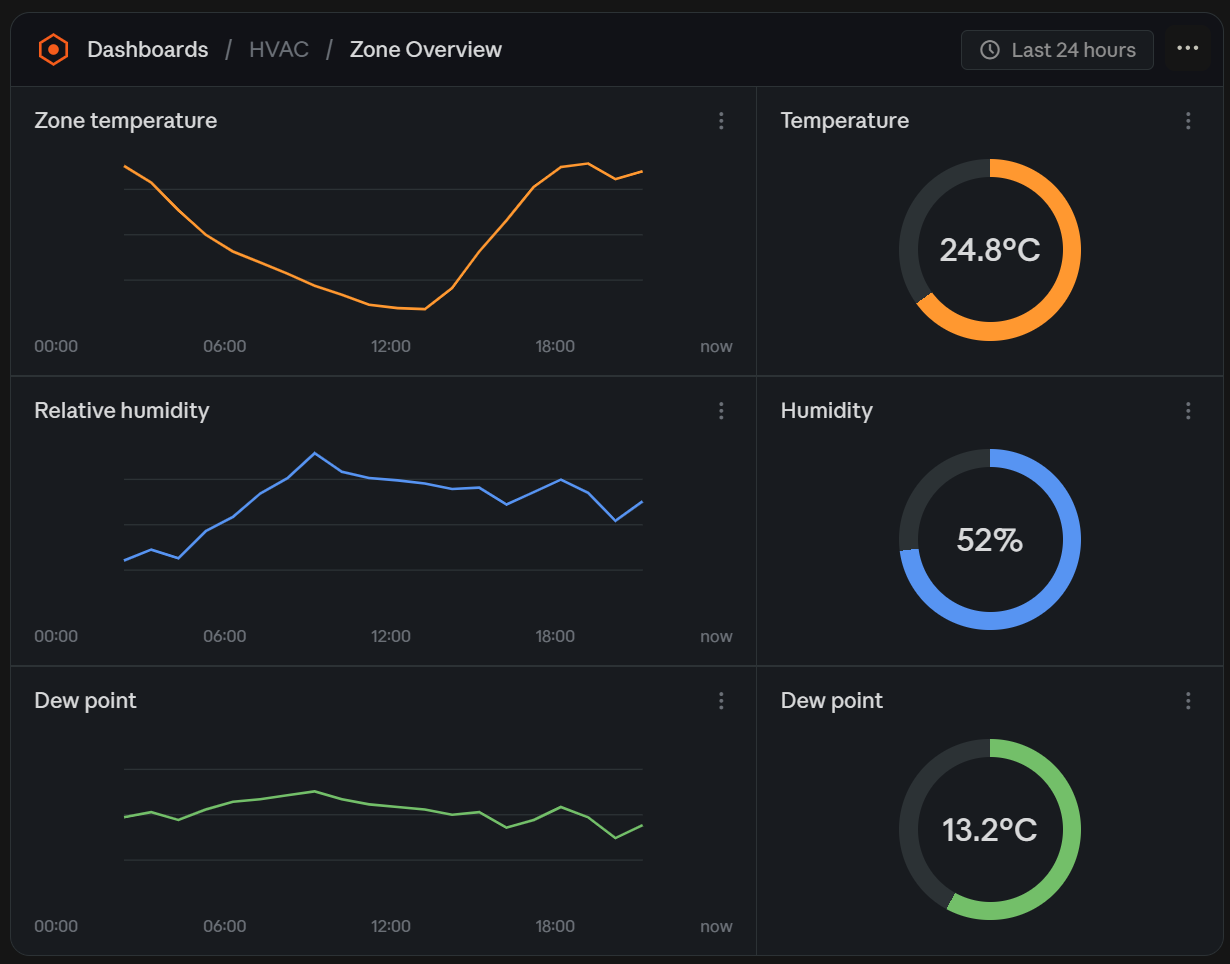
Coffee records trends with a time resolution down to 1 second and sends them to the cloud in real time.
ONE-SECOND RESOLUTION
If connectivity is available, events leave as soon as they are recorded; otherwise they stay in local memory and are transmitted as soon as the system comes back online.
EFFICIENCY MEASURED
By interfacing electricity and heat meters you can measure and assess in real time the performance of a heat pump or of other devices.
DATA YOU CAN QUERY
Data is stored in a database optimised for time series and can be consulted from the WebApp or with specialised tools such as Grafana and Tableau.
“The display is too small”
How many times, especially on premium installations, have you been told that a larger display was missing?
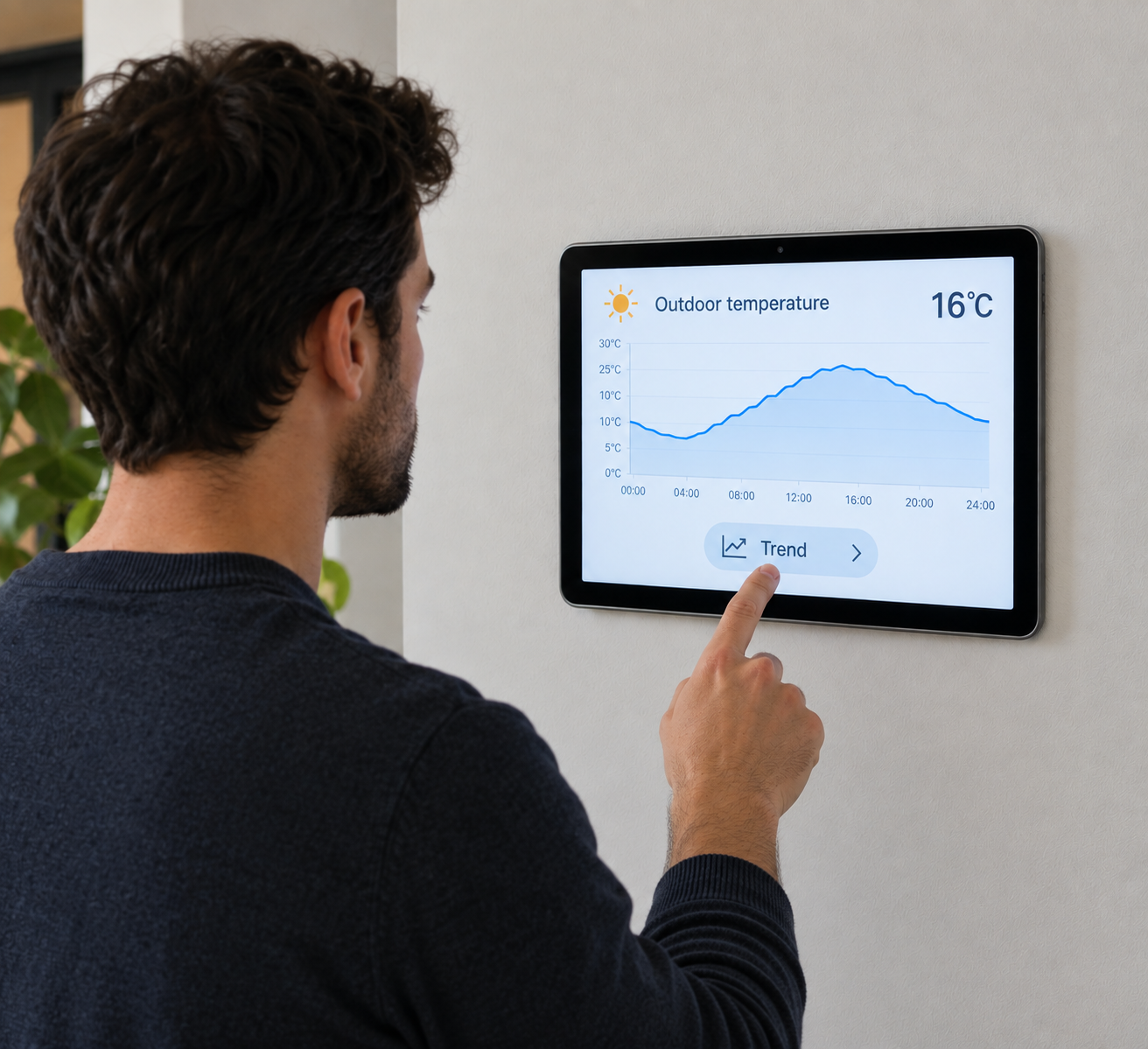
The built-in web server lets you connect locally from a Smart TV, phone or tablet, with no cloud connection required.
The tools to enjoy Coffee at its best
Configuration, portal and user interface have been rewritten from scratch to exploit the event-driven architecture of the system.
COFFEE GRINDER
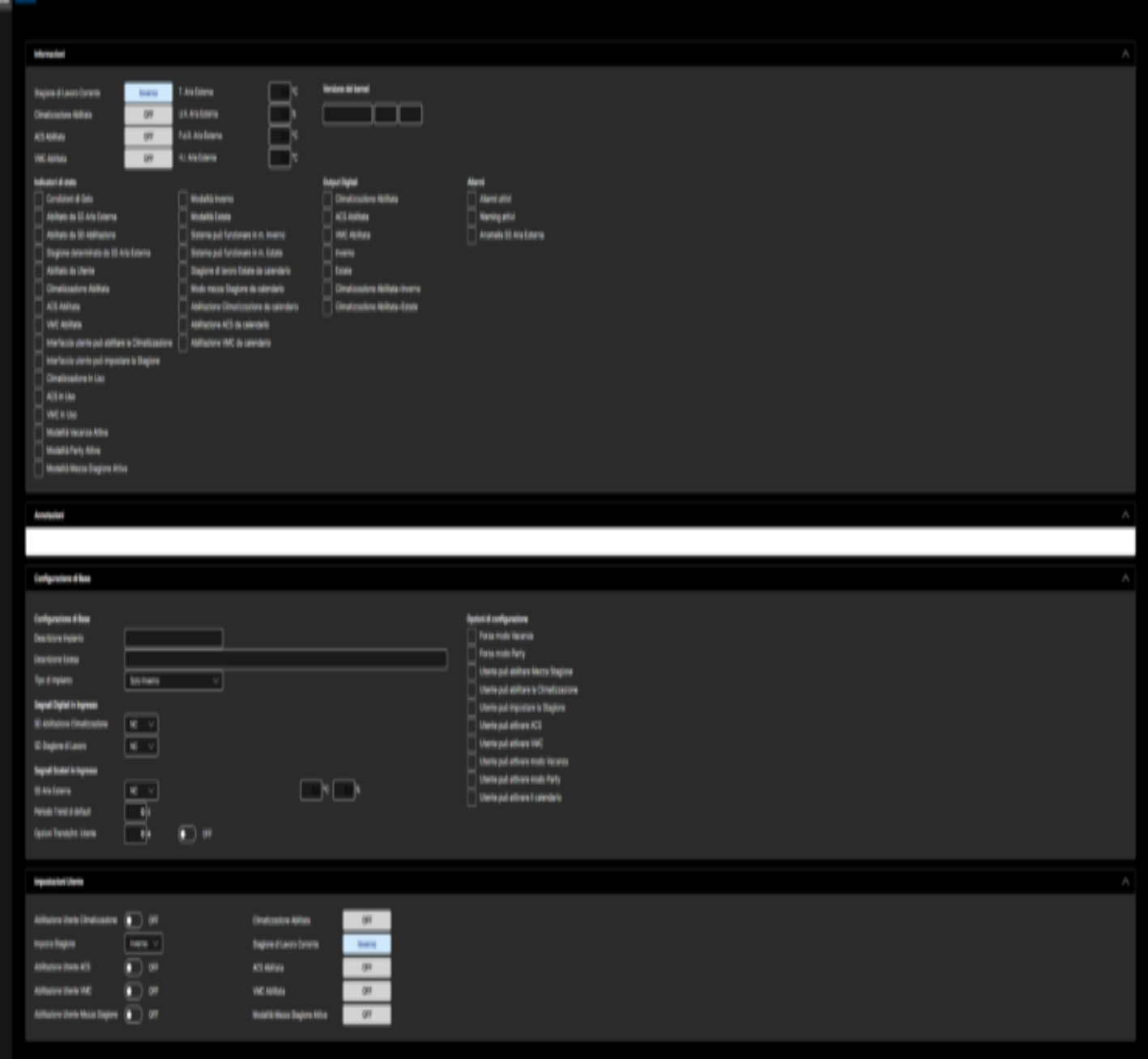
The new configuration tool, rebuilt from scratch to exploit the responsiveness of the adopted protocols. New look and new technology, with a version for Mac as well.
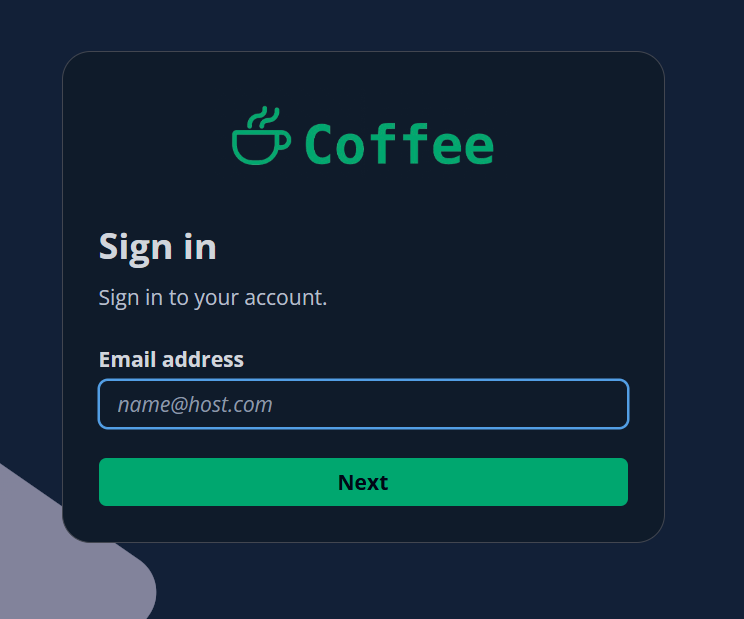
WEB PORTAL AND WEBAPP
The new portal has been completely rewritten to take advantage of the event-driven network architecture, of which it is an integral part.
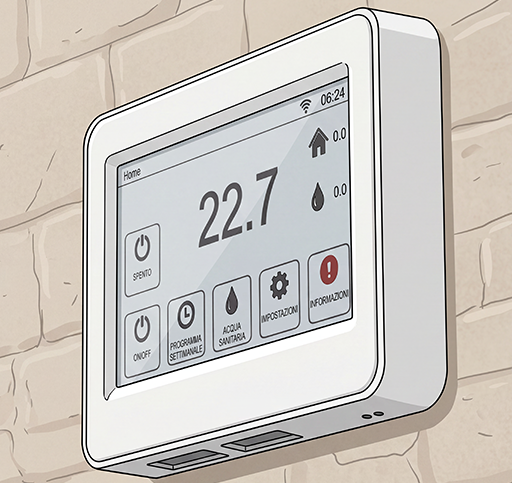
DOT4COFFEE
A specific version of the DOT to be used as the user interface, with a large 4.3″ display and a built-in temperature and humidity sensor.
Barista: the AI agent built into the Coffee system
With so many functions and parameters, the complexity can be daunting. Barista is the help that makes the coffee simple: an AI agent, supporting the configuration and management of the system.
It knows the internal logics and parameters of the Coffee System, it knows the peripherals, the sensors and the devices, and it can operate directly on the configuration of the installation, both locally and remotely.

Coffee and the REG ecosystem
Coffee does not start from scratch: it builds on the expansions and sensors you already know.
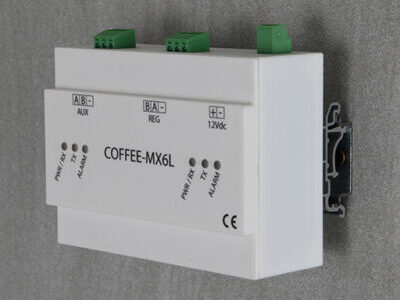
COFFEE MASTER
The heart of every regCOFFEE system, with a LAN interface and two RS485 interfaces (REG + ModBUS peripherals) built in
Explore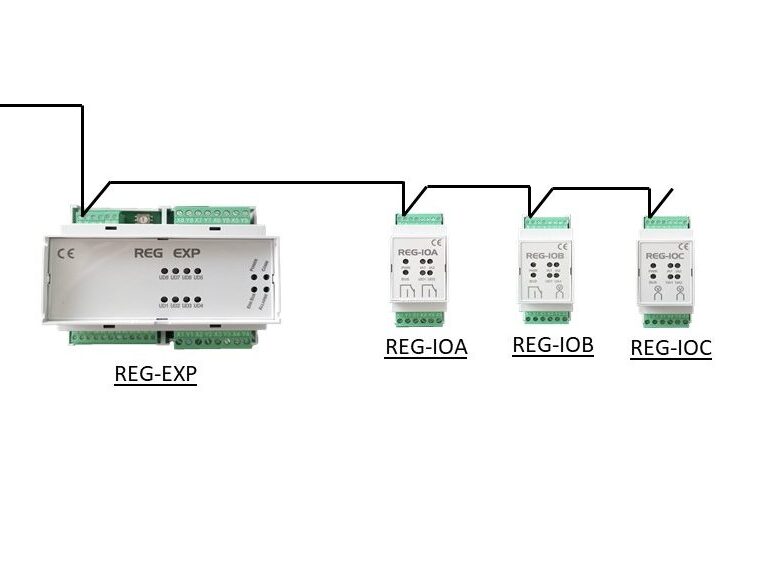
I/O EXPANSIONS
All the I/O expansions of the REG System — EXP, IOx, OTG, MXAB — are compatible with regCOFFEE system masters
Explore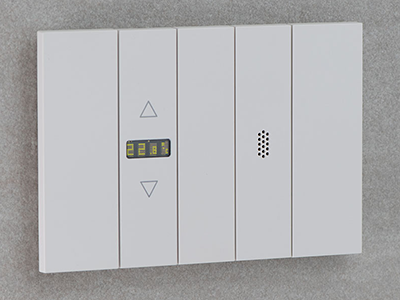
ROOM SENSORS
Temperature, humidity and air quality sensors, flush-mounted, with or without display. Also available for wall mounting
ExploreThe available versions
All versions share the same hardware: the different capacities are defined via software, and can be expanded even on already installed systems .
The base version can replace a REG in most situations, since 16 Coffee zones are far more versatile than 16 REG zones; and once you consider that the LAN interface and a ModBUS port are already built in, a configuration based on Coffee MX6L-16 is very often less expensive than a corresponding REG solution.
COFFEE-MX6L-16
16 Zones, 8 Timers, 8 Manifolds, 4 Sources, 32 L/M Functions, 64+64 sensors and inputs, 64 commands.
COFFEE-MX6L-32
32 Zones, 8 Timers, 8 Manifolds, 4 Sources, 32 L/M Functions, 128+128 sensors and inputs, 128 commands.
COFFEE-MX6L-64
64 Zones, 16 Timers, 16 Manifolds, 8 Sources, 64 L/M Functions, 256+256 sensors and inputs, 256 commands.
COFFEE-MX6L-128
128 Zones, 32 Timers, 32 Manifolds, 16 Sources, 128 L/M Functions, 512+512 sensors and inputs, 512 commands.
